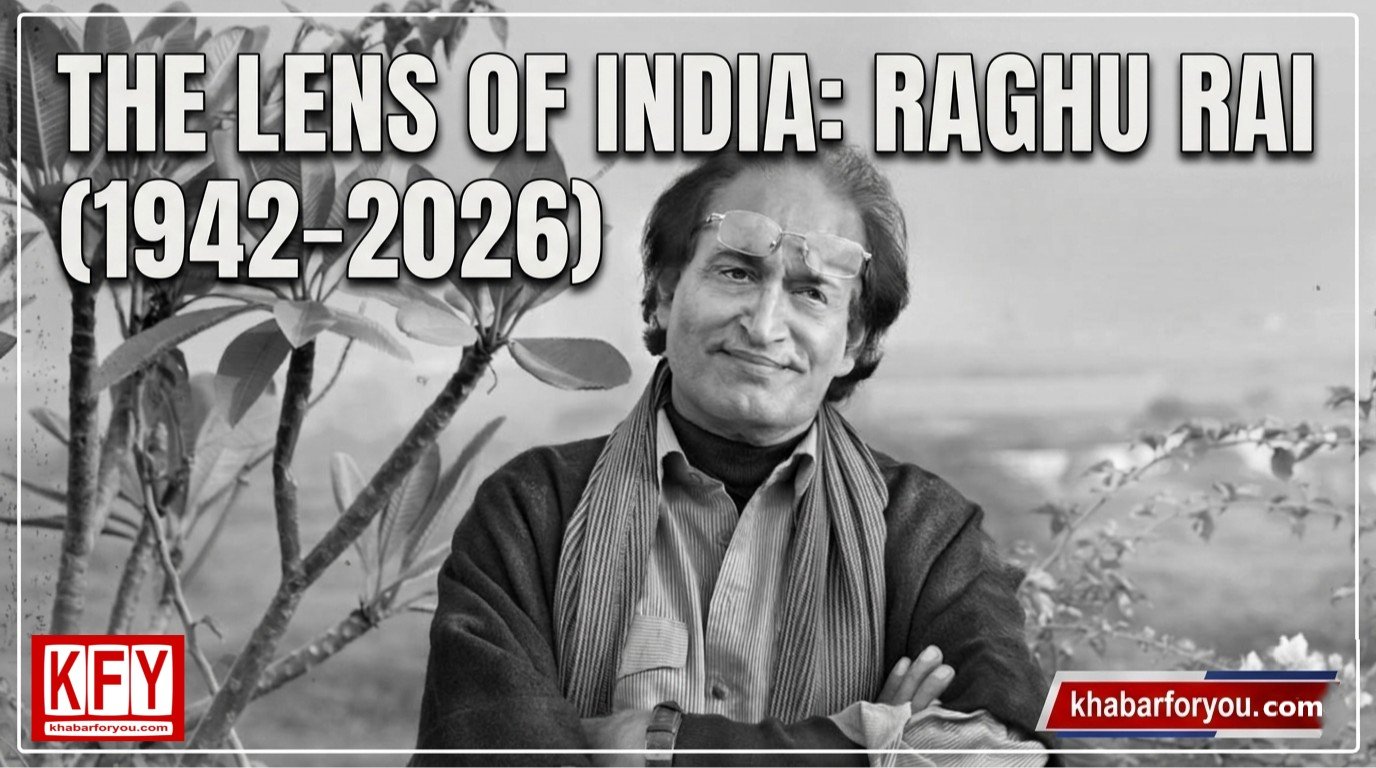
The Lens of India: Raghu Rai (1942–2026) – An Investigative Tribute to the Master of Photojournalism
- Khabar Editor
- 27 Apr, 2026
- 18

Email:-infokhabarforyou@gmail.com
Instagram:-@khabar_for_you


In the early hours of Sunday, as the first light hit the dome of the Jama Masjid - a site he had photographed thousands of times - the shutter finally closed on the most significant career in Indian photojournalism. Raghu Rai, the man who famously claimed he didn’t take pictures but experienced ‘Darshan’ through his viewfinder, passed away at the age of 83.
While the world mourns a legend, an investigative look into his final years reveals a man who was not merely resting on his laurels but was engaged in a frantic, almost spiritual race against time to document an India that he felt was "vanishing beneath the noise of the digital age."
Read More - Raghav Chadha Joins BJP: Inside the "Toxic Work Culture" Allegations & AAP’s Crisis
The Engineering Dropout Who Became India’s Eye
Born in 1942 in Jhang (now in Pakistan), Rai’s journey began not with a sophisticated Leica, but with a borrowed camera and a photograph of a baby donkey. It was an image that made it to The Times, London, and effectively ended his career as a civil engineer before it began.
By 1966, he had joined The Statesman, where his work began to pierce through the clinical nature of news reporting. Unlike his contemporaries, Rai wasn't interested in just the "who, what, and where." He was hunting for the "soul." This instinct caught the eye of the legendary Henri Cartier-Bresson, who nominated Rai to Magnum Photos in 1977. Rai became the first Indian to join the prestigious international photographers' cooperative, effectively putting Indian photojournalism on the global map.
The 'Darshan' Philosophy: More Than Just Optics
To understand Rai is to understand his concept of 'Darshan.' In an exclusive interview given months before his passing, Rai explained to contributors: "Photography is not about the eyes; it is about being available mentally and spiritually to the moment. If you are not silent within, you cannot capture the truth without."
This philosophy was most evident in his coverage of the 1984 Bhopal Gas Tragedy. While others focused on the clinical aftermath, Rai’s image of a child being buried- eyes wide, caked in dust - became the haunting face of industrial negligence. Our investigation into his archives shows that Rai returned to Bhopal repeatedly for thirty years, documenting the slow, painful generational rot, long after the international news cycles had moved on.
The Final Project: The 57th Book
At the time of his death, Rai was reportedly working on his 57th book. Sources close to the Raghu Rai Foundation reveal that this final work was perhaps his most ambitious. Titled tentatively The Changing Raga of India, the project sought to contrast his iconic black-and-white images of the 1960s with the hyper-saturated, neon reality of 2026 India.
"He was frustrated with the 'Instagrammification' of India," says a close associate and former student. "He felt that the depth of the Indian landscape was being flattened into filtered aesthetics. His final mission was to reclaim the 'unfiltered' India."
A Witness to Power and Poverty
Rai’s career was a tightrope walk between the corridors of power and the dusty streets of the common man. He had unprecedented access to Indira Gandhi, capturing her both as a formidable Prime Minister and a lonely matriarch. Yet, in the same breath, he could produce *Mother Teresa: A Life of Dedication*, a book that remains the definitive visual record of the Saint of the Gutters.
The Investigative Angle: The Legacy of the "Physical Negative"
In a world increasingly dominated by AI-generated imagery and digital manipulation - topics Rai spoke against vehemently in his final months - our investigation highlights the immense cultural value of the Raghu Rai Archive. Comprising over half a million negatives, this archive is currently being digitized.
Experts suggest that Rai’s insistence on film for the majority of his career provides a "verifiable visual history" of India that digital pixels cannot mimic. In an era of 'Deepfakes,' Rai’s negatives stand as an incorruptible witness to the Bangladesh War, the Emergency, and the evolution of the Indian middle class.
The Critical Reception: Doyen or Dictator of the Frame?
While celebrated, Rai was also a polarizing figure in the industry. Known for his "tough love" with students and his uncompromising stance on what constituted "real" photography, he often clashed with the younger generation of smartphone photographers.
However, as art critic Girish Shahane notes, "You couldn't ignore him. Even his critics admitted that Rai possessed a 'third eye' for composition. He could find a geometric balance in the chaos of a Delhi railway station that no one else could see."
The Void Left Behind
As the news of his passing spread, tributes poured in from across the globe. From the offices of *The Hindu* to the galleries of Paris, the sentiment was unanimous: the era of the "Grand Master" of Indian photography has ended.
Raghu Rai leaves behind a legacy that is not just a collection of pictures, but a visual encyclopedia of a nation in transition. He didn't just photograph India; he lived it, breathed it, and eventually, he became its most vital visual chronicler.
© 2023 Khabar For You. All Rights Reserved.
Business, Sports, Lifestyle ,Politics ,Entertainment ,Technology ,National ,World ,Travel ,Editorial and Article में सबसे बड़ी समाचार कहानियों के शीर्ष पर बने रहने के लिए, हमारे subscriber-to-our-newsletter khabarforyou.com पर बॉटम लाइन पर साइन अप करें। |
| यदि आपके या आपके किसी जानने वाले के पास प्रकाशित करने के लिए कोई समाचार है, तो इस हेल्पलाइन पर कॉल करें या व्हाट्सअप करें: 8502024040 |
#KFY #KFYNEWS #KHABARFORYOU #WORLDNEWS
नवीनतम PODCAST सुनें, केवल The FM Yours पर
Click for more trending Khabar
Leave a Reply
Your email address will not be published. Required fields are marked *
Search
Category